The angle is set by gauge blocks under the roll, so accuracy comes from the block stack and the roll diameter. That is why a sine vise holds seconds of arc while a graduated tilting vise cannot.
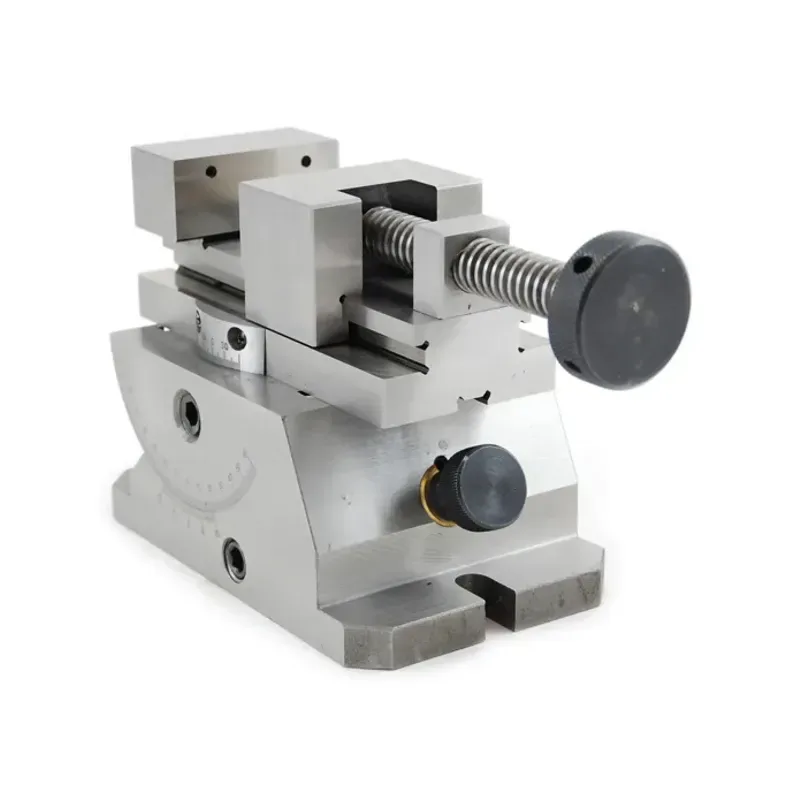 FIG. / PRODUCT VISUAL / 5 VIEWS
Product images are shown for technical review; final compatibility is confirmed before quotation.
TBK-PTV-1601897927046
CHM sine tilting vise, three sizes
A manual sine tilting vise recorded across CHM50, CHM80 and CHM120 at 20 kg, for CNC machine-centre workholding. The sine base sets the angle from gauge blocks, so the tilt is only as accurate as the stack under the roll.
- Models coveredCHM50 / CHM80 / CHM120
- Weight20 kg
- DriveManual
- Model fieldStandard model
- Size fieldCustomizable
| Models covered | CHM50 / CHM80 / CHM120 |
|---|---|
| Drive | Manual |
| Weight | 20 kg |
| Application | CNC machine-centre precision vise |
| Model field | Standard model |
| Size field | Customizable |
| Usage | Workholding precision vise |
| Type recorded | Bench vise |
APPLICATION CHECKCNC machining-center workholdingConfirm machine model, interface and drawing before order.
Request this part Ask about an alternativePRODUCT DETAILTECHNICAL INFORMATION
HOW TO READ THE NUMBERSSine base CHM50 to CHM120 20 kg on a tilted base
Three jaw widths share one record. Pick by part size: a 120 mm body under a 40 mm part wastes height and rigidity on a machine with limited Z travel.
Tilting moves the centre of mass off the mounting bolts. Check the fixture plate for the moment at the maximum angle, not just for the static weight.
WHERE IT DOES NOT FIT
A sine vise sets a known angle on a part that fits between the jaws; it is not a rotary axis and not presented for heavy cutting at large tilt angles, where the roll loads on one edge. No parallelism or maximum angle is recorded.
WHAT THIS RECORD ANSWERS
Are gauge blocks included?
Not recorded. The sine principle needs a block stack; assume it is not supplied unless the quotation says so.
What is the maximum tilt?
Not recorded. The usable angle depends on the roll and part clearance.
Which size for a 100 mm part?
CHM120 is the closest of the three, but jaw opening is not recorded, so confirm before ordering.
SPECIFICATION INPUT
Exact fit starts with the machine.
Specifications are listed with the part. Confirm machine model, interface, material and drawing before quotation.
INPUT / 2D + 3D DRAWINGCHECK / INTERFACE + MATERIALOUTPUT / QUOTATION ROUTE