Twenty micrometres per 100 mm is a working tolerance for a production vise, not a toolroom figure. It is enough for most milling fixtures and not enough to skip indicating when the drawing is ±0.02 mm.
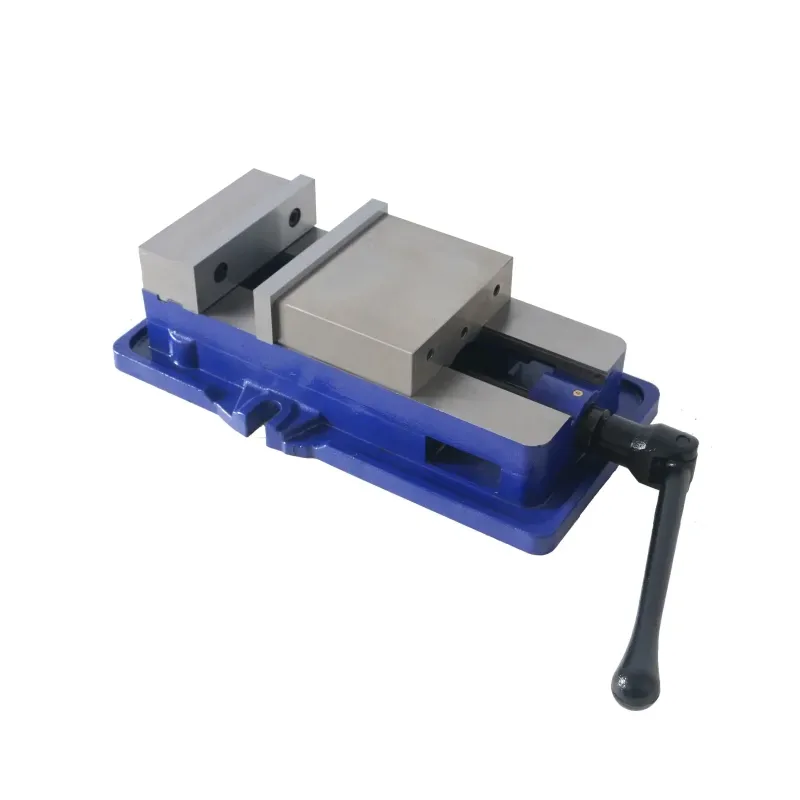 FIG. / PRODUCT VISUAL / 5 VIEWS
Product images are shown for technical review; final compatibility is confirmed before quotation.
TBK-PV-PS-1601034462269
DFV-5-180 compact power vise
A compact power angle-lock vise recorded as DFV-5-180 in nodular cast iron at 45 kg, with parallelism stated as 0.02 mm per 100 mm, for CNC machining centres. The angle-lock mechanism multiplies handle force, so the clamping load is set by the mechanism rather than by how hard the operator turns.
- Model referenceDFV-5-180
- Parallelism0.02 mm / 100 mm
- Weight45 kg
- MaterialNodular cast iron
- DriveManual, angle-lock
| Model reference | DFV-5-180 |
|---|---|
| Material | Nodular cast iron |
| Parallelism | 0.02 mm / 100 mm |
| Weight | 45 kg |
| Drive | Manual, angle-lock |
| Application | CNC machining centre |
| Colour | Silver |
| Usage | Workholding precision vise |
APPLICATION CHECKCNC machining centers and milling-machine workholdingConfirm machine model, interface and drawing before order.
Request this part Ask about an alternativePRODUCT DETAILTECHNICAL INFORMATION
HOW TO READ THE NUMBERS0.02 mm / 100 mm Angle-lock drive 45 kg
The mechanism converts handle torque into clamping force through a wedge, so the force is repeatable between operators. That repeatability, not the raw force, is what keeps part-to-part variation down.
At 45 kg this is a fixed-station vise. Plan where it lives on the table before it arrives; moving it between machines is a two-person job with a hoist.
WHERE IT DOES NOT FIT
It is a production workholding vise, not a precision instrument: at 0.02 mm per 100 mm it is not presented for gauging or for parts held to ±0.01 mm without indicating. No clamping force figure is recorded.
WHAT THIS RECORD ANSWERS
What is the jaw opening?
Not recorded. The model suggests a 180 mm class, but the opening is not stated as a field.
Is it hydraulic or mechanical?
The record describes a compact power angle-lock vise with manual drive, so it is a mechanical multiplier rather than a hydraulic vise.
Why nodular cast iron?
Nodular iron is tougher than grey iron, so the body resists cracking around the clamping wedge — the part that takes the load.
SPECIFICATION INPUT
Exact fit starts with the machine.
Specifications are listed with the part. Confirm machine model, interface, material and drawing before quotation.
INPUT / 2D + 3D DRAWINGCHECK / INTERFACE + MATERIALOUTPUT / QUOTATION ROUTE