Four flutes is the usual compromise for steel and stainless: twice the feed of a two-flute cutter while keeping enough chip room. Aluminium tends to weld onto four flutes, so that work belongs on a two- or three-flute tool.
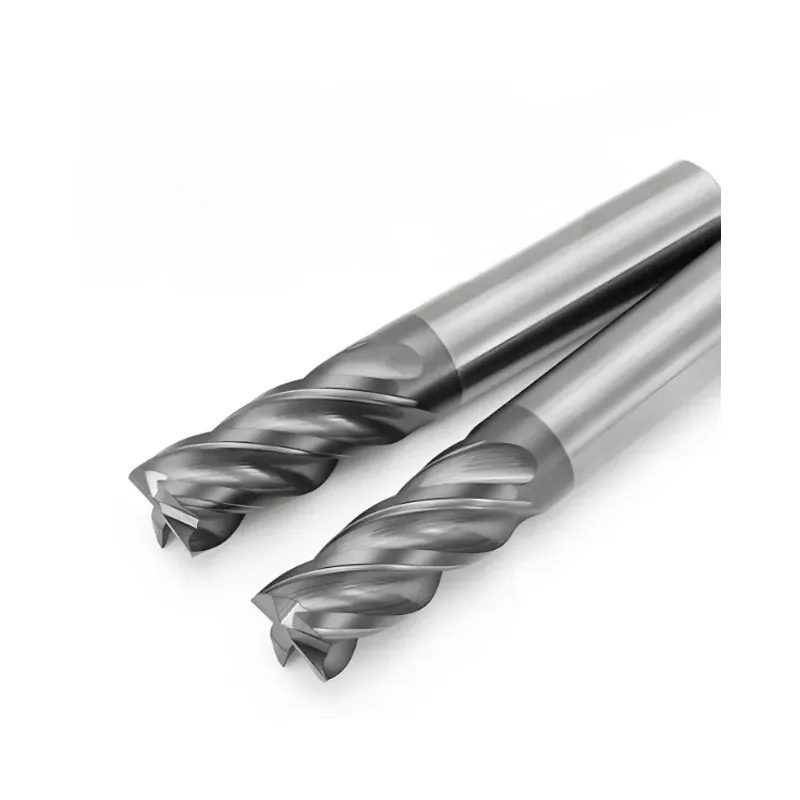 FIG. / PRODUCT VISUAL / 5 VIEWS
Product images are shown for technical review; final compatibility is confirmed before quotation.
TBK-END-CTH-1601683213773
4-flute TiAlN end mill
A 4-flute square-end solid carbide cutter in grade YG8 with TiAlN coating, offered from 6 to 20 mm diameter with a 38–45° helix. The record lists it for hardened and stainless steel on machining centres and milling machines.
- Flutes / end type4 flutes, square end (Weldon flat optional)
- SubstrateSolid carbide, YG8
- Helix angle38°–45°
- Cutting diameter6–20 mm
- Flute / overall length15–50 mm
| Flutes / end type | 4 flutes, square end (Weldon flat optional) |
|---|---|
| Coating | TiAlN |
| Substrate | Solid carbide, YG8 |
| Helix angle | 38°–45° |
| Cutting diameter | 6–20 mm |
| Flute / overall length | 15–50 mm |
| Cutting direction | Right hand |
| Workpiece hardness | ≤ 55 HRC |
APPLICATION CHECKCNC milling machine and machining-center applicationsConfirm machine model, interface and drawing before order.
Request this part Ask about an alternativePRODUCT DETAILTECHNICAL INFORMATION
HOW TO READ THE NUMBERS4 flutes 38°–45° helix ≤ 55 HRC
A higher helix cuts more freely and clears chips better, at the cost of more axial force and more chatter on thin walls. The range itself says this is a general-purpose geometry rather than one optimised for a single material.
This limits the workpiece, not the cutter. Hardened parts above 55 HRC need CBN or ceramic; carbide wears through quickly at that level.
WHERE IT DOES NOT FIT
TiAlN protects the edge through an oxide layer that forms at temperature, so it suits dry cutting or minimum quantity lubrication. Flood coolant suppresses that layer. It is not the right coating for aluminium or copper, which load the flutes.
WHAT THIS RECORD ANSWERS
How many flutes?
Four.
What coating?
TiAlN.
How hard a workpiece?
Up to 55 HRC.
SPECIFICATION INPUT
Exact fit starts with the machine.
Specifications are listed with the part. Confirm machine model, interface, material and drawing before quotation.
INPUT / 2D + 3D DRAWINGCHECK / INTERFACE + MATERIALOUTPUT / QUOTATION ROUTE