One flute leaves the largest possible chip channel for a given diameter, which is what stops soft plastics from re-welding behind the cut. The trade-off is feed per revolution: a single flute removes half what a two-flute tool removes at the same rpm.
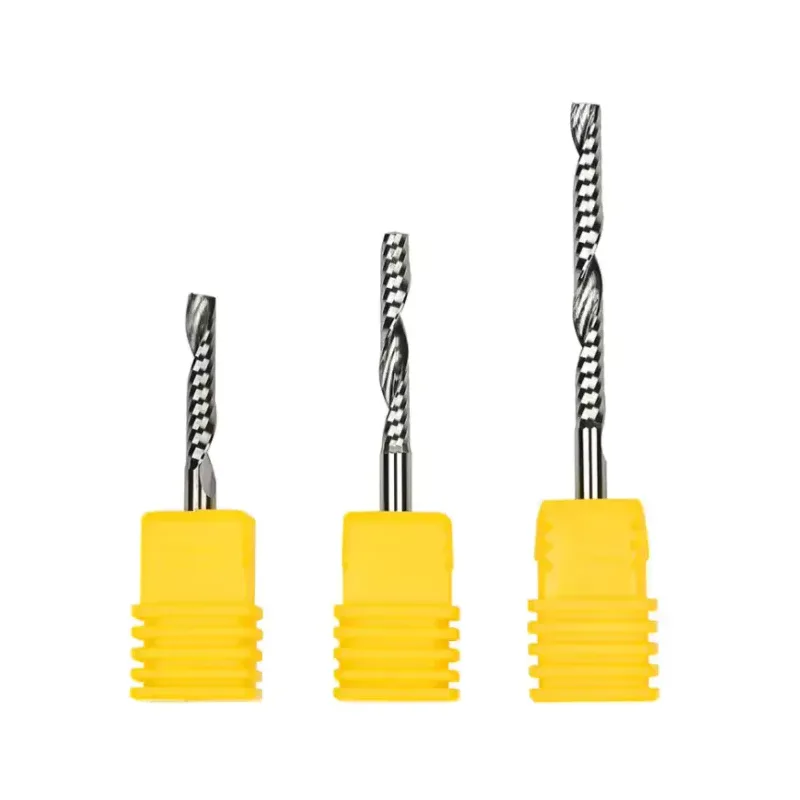 FIG. / PRODUCT VISUAL / 4 VIEWS
Product images are shown for technical review; final compatibility is confirmed before quotation.
TBK-END-1600067353357
HRC55 single-flute router bit D3.175
A single-flute solid carbide router bit recorded as model D3.175 with a straight 3.175 mm shank, uncoated and listed at 55 HRC. One flute leaves a large chip channel, which is what keeps acrylic, PVC and MDF from welding to the edge.
- Model numberD3.175
- Flutes1
- ShankStraight, 3.175 mm
- Hardness55 HRC
- CoatingUncoated
| Model number | D3.175 |
|---|---|
| Flutes | 1 |
| Shank | Straight, 3.175 mm |
| Hardness | 55 HRC |
| Coating | Uncoated |
| Cutting direction | Climb milling |
| Down-cut option | Left spiral offered |
| Materials listed | Acrylic, PVC, MDF, solid wood, plastic board |
APPLICATION CHECKCNC milling machine and machining-center applicationsConfirm machine model, interface and drawing before order.
Request this part Ask about an alternativePRODUCT DETAILTECHNICAL INFORMATION
HOW TO READ THE NUMBERS1 flute 3.175 mm shank Uncoated
That is the 1/8 inch collet size, so it drops into a standard router spindle or a trim-router collet without an adapter. The cutting diameter is not recorded separately from the shank.
Uncoated carbide is the normal choice for acrylic, PVC and wood: coatings add heat resistance that these materials do not need, and a polished uncoated face clears chips better.
WHERE IT DOES NOT FIT
Soft plastics, wood and MDF are what the record supports. It is not presented for steel, and for aluminium the single-flute geometry only works with the right chip load and lubrication — a zero-rake uncoated bit will gall on aluminium if fed too slowly.
WHAT THIS RECORD ANSWERS
Up-cut or down-cut?
The record lists a left-spiral down-cut option alongside a climb-milling direction. Down-cut protects the top face of veneered board; up-cut clears chips faster in deep cuts.
What is the cutting diameter?
Not recorded. Only the 3.175 mm shank is stated, so the cutting diameter has to be confirmed before ordering.
Can it cut aluminium?
The description mentions aluminium while the recorded material list names plastics and wood only. Treat aluminium as unconfirmed and test a sample before committing a job.
SPECIFICATION INPUT
Exact fit starts with the machine.
Specifications are listed with the part. Confirm machine model, interface, material and drawing before quotation.
INPUT / 2D + 3D DRAWINGCHECK / INTERFACE + MATERIALOUTPUT / QUOTATION ROUTE