This is combined runout of the taper and the collet bore, and it sets the tool's real rotation accuracy. In milling it turns into a per-tooth chip-thickness difference, which shows up as chatter marks and as tool-life scatter.
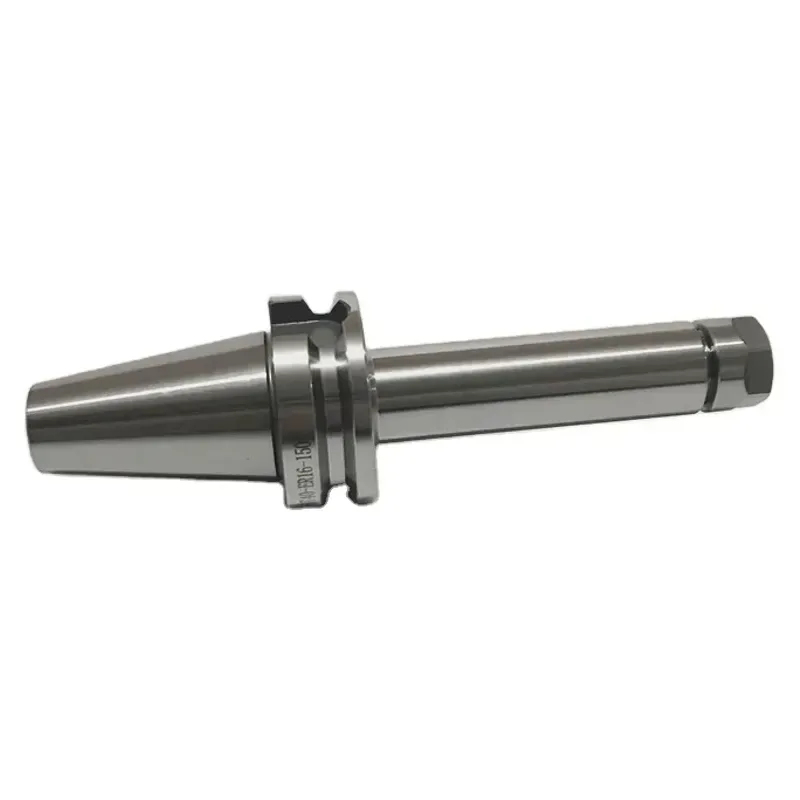 FIG. / PRODUCT VISUAL / 3 VIEWS
Product images are shown for technical review; final compatibility is confirmed before quotation.
TBK-COLLET-1601370557254
BT30 / BT40 precision collet chuck
A BT-series collet chuck arbor in hardened steel at HRC 56-58, with maximum runout below 0.005 mm, AT3 taper tolerance and dynamic balance stated from 12,000 to 20,000 rpm. Listed for BT30 with ER32 and BT40 with ER20, to MAS403 and B6339.
- TaperBT30 with ER32 / BT40 with ER20
- Max runout< 0.005 mm
- Taper tolerance< AT3
- Dynamic balance12,000–20,000 rpm
- Body hardnessHRC 56-58
| Taper | BT30 with ER32 / BT40 with ER20 |
|---|---|
| Max runout | < 0.005 mm |
| Taper tolerance | < AT3 |
| Dynamic balance | 12,000–20,000 rpm |
| Body hardness | HRC 56-58 |
| Surface roughness | Ra < 0.005 mm (as recorded) |
| Cooling | A / AD / AD+B |
| Standards | MAS403, B6339 |
APPLICATION CHECKCNC tooling, lathe and workholding applicationsConfirm machine model, interface and drawing before order.
Request this part Ask about an alternativePRODUCT DETAILTECHNICAL INFORMATION
HOW TO READ THE NUMBERS< 0.005 mm runout AT3 12,000–20,000 rpm
A taper contact accuracy class, with AT3 being precision grade. If the taper contact is poor, the stated 0.005 mm is gone the moment a tool is loaded, which makes this figure worth confirming more than the runout number.
The speed band the balance grade covers, not a maximum. Above it, centrifugal force lets the holder creep on the spindle taper and both accuracy and life fall away.
WHERE IT DOES NOT FIT
A BT shank will not fit a DIN or HSK spindle. The A, AD and AD+B cooling options combine centre-through and ring coolant, and the wrong connection either leaks or cools nothing. The collet series is fixed by the body and cannot be swapped to another.
WHAT THIS RECORD ANSWERS
What runout?
< 0.005 mm.
What taper class?
AT3.
What balance speed?
12,000–20,000 rpm.
SPECIFICATION INPUT
Exact fit starts with the machine.
Specifications are listed with the part. Confirm machine model, interface, material and drawing before quotation.
INPUT / 2D + 3D DRAWINGCHECK / INTERFACE + MATERIALOUTPUT / QUOTATION ROUTE