A slotted sleeve clamps by elastic deformation, which absorbs small shank diameter variation and suits tooling whose shanks are not perfectly consistent. The price is slightly lower rigidity than a solid sleeve under heavy cuts.
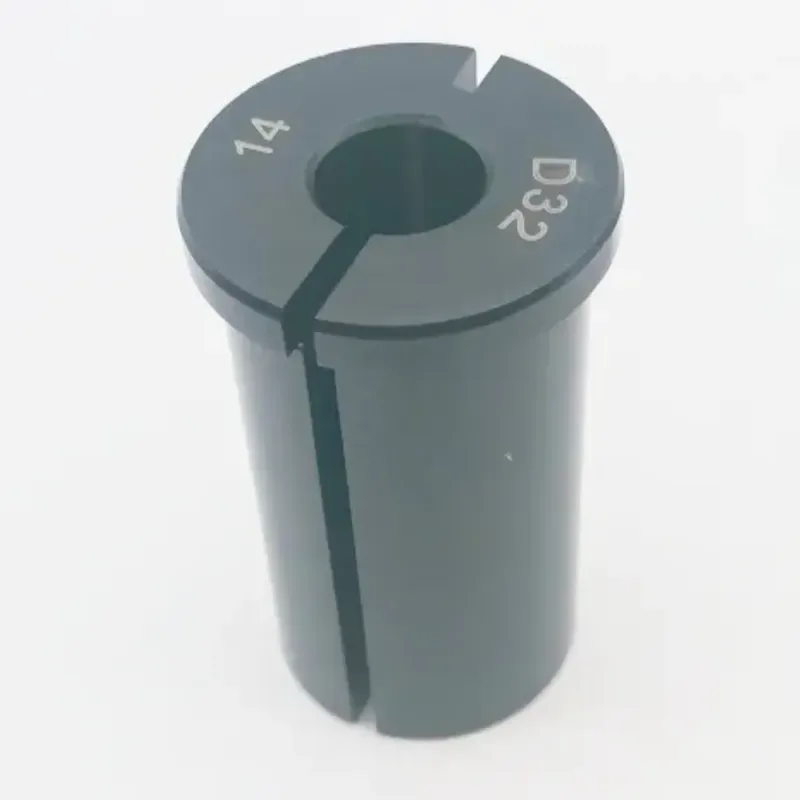 FIG. / PRODUCT VISUAL / 5 VIEWS
Product images are shown for technical review; final compatibility is confirmed before quotation.
TBK-ARB345-1601673220917
Elastic adapter sleeve, Morse taper
An elastic (slotted) tool-holder bushing in 40CrMo at HRC 50-55, with accuracy of 0.015 mm and 0.01 mm, models from D16 to D60 and a Morse-taper reduction variant, listed for milling, lathe, grinding, drilling and boring machines.
- Material40CrMo
- HardnessHRC 50-55
- Accuracy0.015 mm / 0.01 mm
- ModelsD16 / D20 / D25 / D32 / D40 / D50 / D60
- Weight1 kg
| Material | 40CrMo |
|---|---|
| Hardness | HRC 50-55 |
| Accuracy | 0.015 mm / 0.01 mm |
| Models | D16 / D20 / D25 / D32 / D40 / D50 / D60 |
| Type | Elastic (slotted) sleeve, Morse taper reduction |
| Machines | Milling, turning, grinding, drilling, boring |
| Weight | 1 kg |
APPLICATION CHECKCNC machining and tool-holder applicationsConfirm machine model, interface and drawing before order.
Request this part Ask about an alternativePRODUCT DETAILTECHNICAL INFORMATION
HOW TO READ THE NUMBERSElastic, slotted 0.015 / 0.01 mm D16–D60
The same two grades as the solid sleeve. Note that an elastic sleeve is measured after clamping: an unloaded measurement tells you nothing useful.
The same size designations as the straight-shank sleeve, but a different job: this one reduces a Morse taper. Identical model numbers do not make the two interchangeable.
WHERE IT DOES NOT FIT
Not for high-torque heavy cutting. Chips collect in the slots, so clean after cast iron or aluminium or clamping force drops. A damaged Morse taper loses accuracy immediately.
WHAT THIS RECORD ANSWERS
How does it differ from a solid sleeve?
It is slotted, so it absorbs shank tolerance; a solid sleeve is more rigid.
What accuracy?
0.015 mm and 0.01 mm, measured after clamping.
Which machines?
Milling, turning, grinding, drilling and boring.
SPECIFICATION INPUT
Exact fit starts with the machine.
Specifications are listed with the part. Confirm machine model, interface, material and drawing before quotation.
INPUT / 2D + 3D DRAWINGCHECK / INTERFACE + MATERIALOUTPUT / QUOTATION ROUTE