After the sheet is bonded: where the allowance goes
The sheet is the only part of the job with a number attached. Everything that decides the final height sits between the sheet and the tool, and none of it is written in the records.
Bonding a Turcite sheet to a slideway is the easy half. The half that decides whether the machine cuts to size is the bookkeeping afterwards: how much material the sheet adds, how much the machining pass removes, and how much the scraper takes off before the surface carries load evenly. This page works through that bookkeeping using the six records in the Turcite B family and nothing else. Where a value is absent, the page says so rather than supplying a plausible figure.
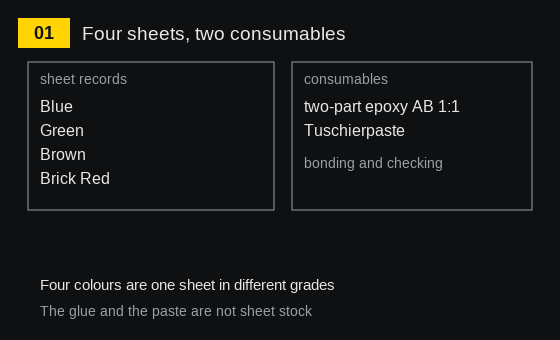
Six records, four of which are sheet
The family holds four sheet records, one for each colour, plus two records that are not sheet at all: a two-part epoxy adhesive at a 1:1 ratio, and Tuschierpaste, the marking paste used to read contact. Treating the family as six sheets of material would be a mistake; two of the six are what makes the sheet stay on and what tells you whether it is flat.
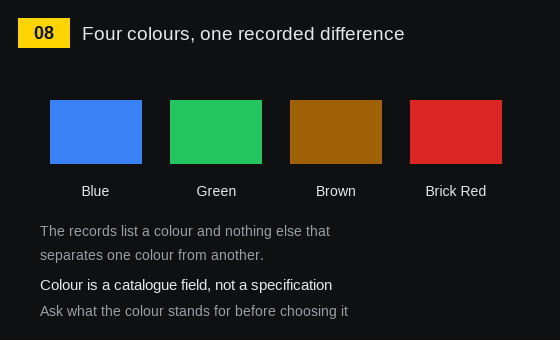
All four sheet records share the same material line, a PTFE-based slideway bearing material, and the same width and thickness fields. The only field that separates them is the listed colour. That is worth stating plainly, because a buyer scanning a colour list will assume the colours encode grades. Nothing in these six records says they do.
The sheet gives you a band, not a size
Three of the four sheet records state thickness as listed sizes from 0.8 to 3.2 mm. The fourth, the brick red sheet, writes confirm against requirement in the thickness field, and pushes the actual list into the product name, which names 1/32 inch, 1/16 inch, 0.5, 0.8, 1.0, 1.2, 1.5, 1.6 and 2.0 mm. So the one record with a detailed thickness list is the one whose specification field refuses to commit.
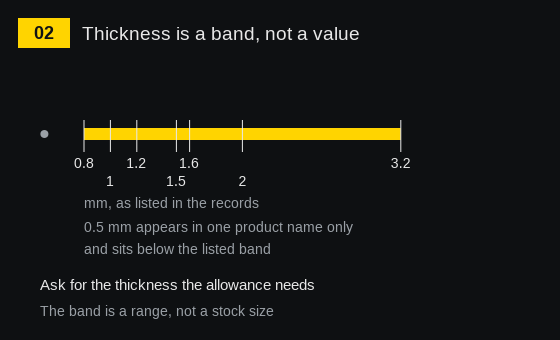
A band is the right shape for this decision, but only if you read it backwards. You do not pick a thickness and then work out what fits. You work out the allowance the job needs, then pick the thinnest sheet in the band that still covers it, because every extra tenth of a millimetre is material the scraper has to remove by hand.
Width: why 305 mm exists
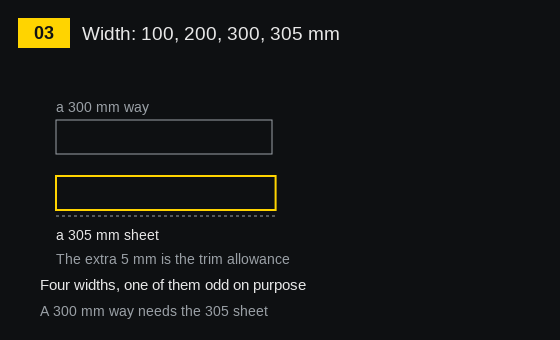
Widths are listed as 100, 200, 300 and 305 mm on all four sheets. The odd number is not a typing error. A 300 mm way needs a sheet slightly wider than the way so the edge can be trimmed after bonding, and 300 mm of sheet on a 300 mm way leaves nothing to trim. The 305 mm option is the trim allowance, and it is the width to order when the way measures 300.
The stack after bonding
Once the sheet is down, four layers sit between the casting and the cutting tool: the bed, the glue line, the sheet, and the machined and scraped face. Only one of those has a number in the records, and it is the sheet.
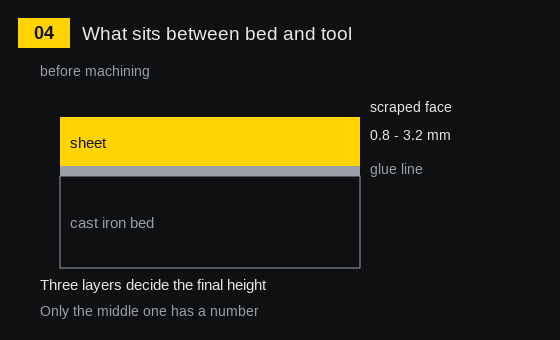
The glue line is the layer people forget when they estimate. A two-part epoxy at 1:1 does not bond metal to metal with zero thickness, and the records state the mixing ratio but not the cured film thickness, the open time or the clamp time. Those three numbers decide how much the assembly grows before machining starts, and all three have to come from the adhesive supplier or from your own trial.
The allowance equation
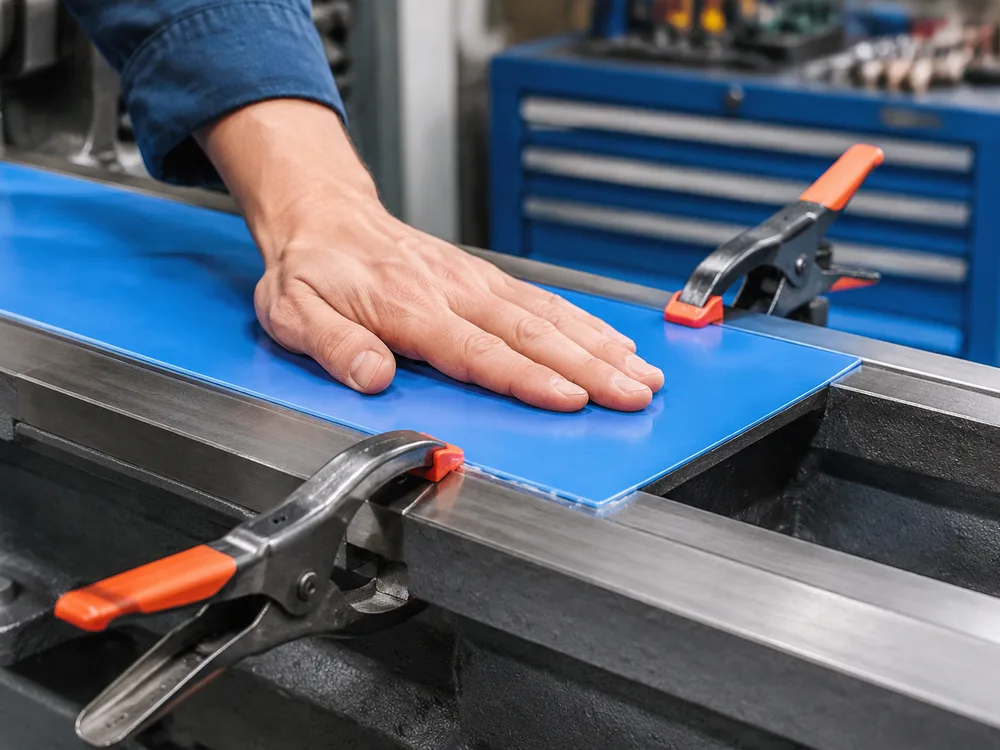
Written out, the job is one subtraction. Sheet thickness, minus the amount removed by machining, minus the amount removed by scraping, equals the final height above the bed. The first term comes from the record band. The second comes from how much distortion the bonding introduced and how much the way has to be re-cut to restore geometry. The third comes from the contact pattern you are willing to accept.
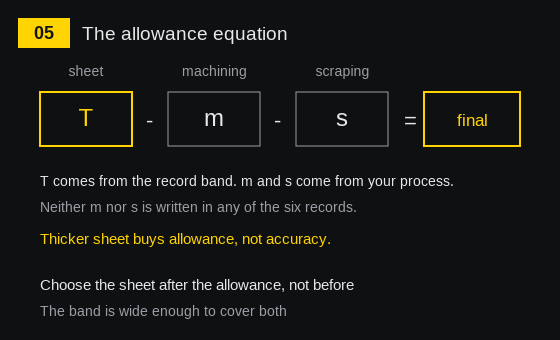
None of the six records contains a machining allowance or a scraping allowance. That is not an omission to be patched with an average; it is a division of responsibility. The supplier states what the sheet is. The fitter states how much comes off. A page that invented a figure for either would be handing you a number that fails the first time it meets a worn bed.
Thicker is not more accurate
It is tempting to order the thickest sheet in the band, on the reasoning that more material means more room to correct. In practice the thickest sheet means the most scraping, and scraping is where the hours go and where the flatness error is introduced if the work is rushed. The right choice is the thinnest sheet that still leaves enough for the machining pass and the contact pattern. If the bed is badly worn, the answer is to correct the bed, not to buy 3.2 mm of sheet and cut most of it away. A thick sheet also hides a bed that is still moving, because the error reappears as soon as the scraper stops taking material.
The paste reads contact; it does not create it
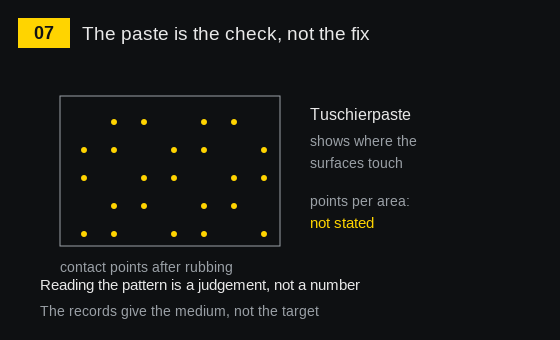
Tuschierpaste is the check medium. Spread thin on the reference surface, rubbed against the scraped sheet, it marks the high points, and the pattern tells the fitter where to take another pass. The records state the product type and that it is used for fitting and checking. They do not state a target contact count per unit area, and the number that matters is the one your machine builder specified, not a generic figure.
OEM size means cut to your drawing
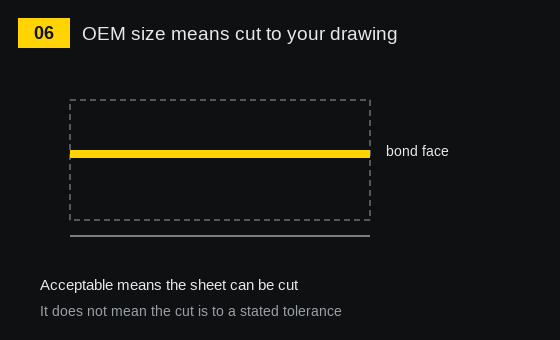
Four of the six records carry an OEM size field reading acceptable. That word gets read as a promise about tolerance, and it is not one. It means the sheet can be supplied cut to the length and width your drawing calls for, instead of only in stock sheet sizes. How close that cut lands is not stated in the record, so the cut edge has to be treated as a rough edge that gets trimmed or scraped after bonding.
What the six records never state
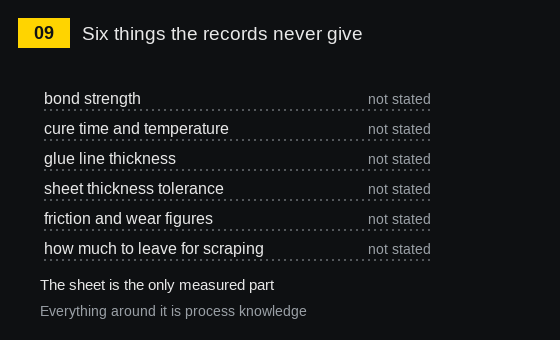
Reading the six records together, the missing values are consistent across the family rather than scattered: bond strength, cure time and cure temperature, cured glue line thickness, sheet thickness tolerance, friction and wear figures, and the amount to leave for scraping. Any of those can be established by test or by the adhesive datasheet. None of them can be read off this catalogue, and a quotation that quietly supplies them is quoting something it does not have.
How to order without guessing
Five things settle the order, and all five come from the machine rather than from the catalogue. The way width, so the trim allowance can be added. The length, cut to the drawing. The distortion the bed already carries, which decides how much machining follows. The final height the geometry needs above the bed. And the contact pattern the machine builder specified, which decides how much of the sheet stays.
Send those five numbers with the way dimensions and the colour you want, and the sheet can be cut to the band that covers the allowance. The reading of a worn way, the decision to re-bond rather than re-scrape, and the arithmetic that separates a sheet job from a bed job are set out in Turcite B guideway relining, which takes the same six records from the other direction.
The four sheets are listed in Turcite B sheets with their width and thickness fields, and the adhesive and the paste sit beside them in the same family so the consumables are not ordered from a different page and a different set of assumptions.