I/O and servo matching on a CNC controller: what 95 records actually state
Matching a controller to a machine takes five numbers. In this family of ninety-five records, two state an I/O count, two state a pulse rate, and nineteen state an axis count that is often written as a range instead of a figure.
Matching is a subtraction
Matching a controller to a machine is arithmetic dressed as a purchase. The machine needs a number of interpolating axes, a number of inputs and outputs, a pulse rate fast enough for the rapids it runs, a drive interface its amplifiers accept, and a logic supply its cabinet already provides. The controller supplies some maximum of each. The match is the difference, and the only question that matters is whether every difference comes out positive.
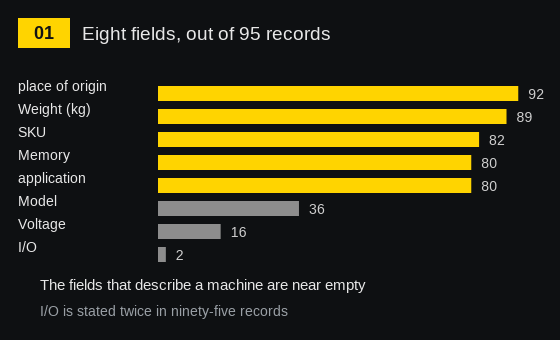
That calculation needs five numbers per side. The records in this family supply them unevenly, and the unevenness is not random: the fields that are easy to copy from a data sheet are full, and the fields that decide the match are nearly empty.
Ninety-five records, ninety-four of them carrying a field count in the nineties for origin and weight, and two carrying an I/O count. The order of those two facts is the whole story of this article.
Axis count wears four names
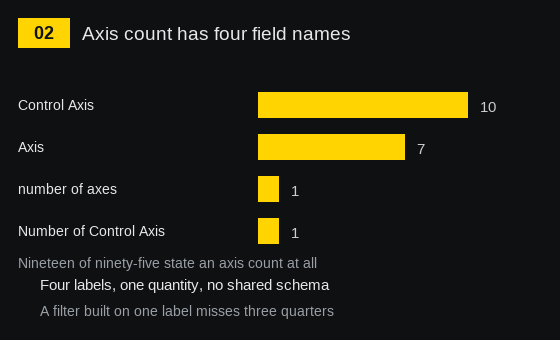
The first surprise is that axis count is not one field. It appears as Control Axis in ten records, as Axis in seven, as number of axes once, and as Number of Control Axis once. Nineteen records in total, spread across four spellings that no filter would catch together.
A buyer building a shortlist on one of those labels sees ten candidates. The family actually offers nineteen. That is not a data-entry accident so much as a market with no shared schema: each seller names the column after the phrase that felt natural on the day of upload.
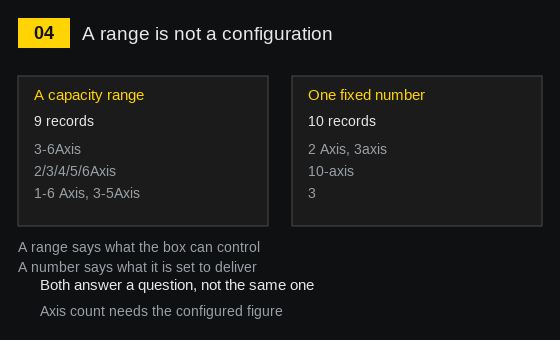
The second surprise is what the values say. Nine of the nineteen write a capacity range: 3-6Axis, 2/3/4/5/6Axis, 1-6 Axis, 3-5Axis. Ten write a single figure: 2 Axis, 3axis, 10-axis. A range describes what the controller can be configured to control. A single figure describes what it is set to deliver. Those are different claims, and only one of them belongs in a matching calculation.
The I/O string
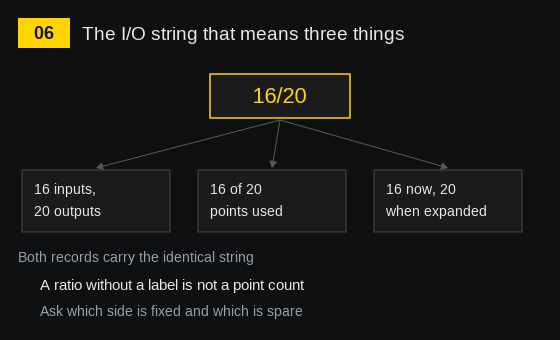
An I/O count appears in two records, and both write the same string: 16/20. That string is a ratio without a label. It can mean sixteen inputs and twenty outputs, or sixteen of twenty points in use with four spare, or sixteen fitted now and twenty when an expansion board arrives.
The three readings lead to three different machines. A cabinet that needs twenty discrete outputs cannot be built on the first reading if the twenty is actually an expansion ceiling. A cabinet that already uses sixteen of twenty points has no room for the safety relay the next project adds.
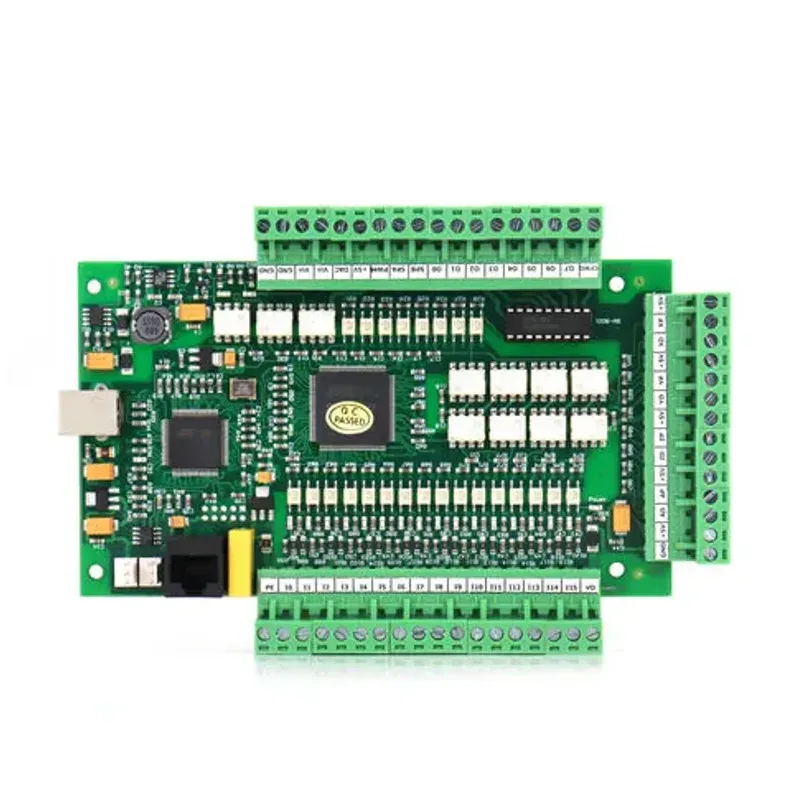
A board of this kind is what the string is describing: terminals in labelled rows, inputs on one edge and outputs on the other. Counting them is the only way to turn the string into a number, and it takes a minute with the board in hand or a clear photograph of both edges.
The practical consequence is simple. The I/O count has to be confirmed in writing, and the confirmation has to name both directions: how many inputs are live, how many outputs are live, and whether either side can be extended.
Pulse rate, two records, two styles
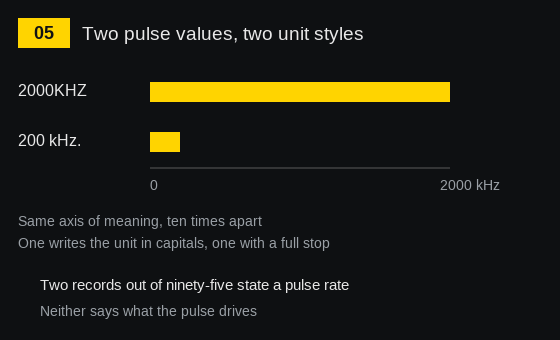
Two records state a pulse rate, one as 2000KHZ and one as 200 kHz. The 2000KHZ entry belongs to a 3/4-axis USB motion control card. The spellings differ and so do the values, by a factor of ten. Neither record says what the pulse is driving: a pulse rate means nothing until it is paired with the resolution of the axis it feeds.
Read them the way an engineer reads a sales sheet: as an upper bound on what the output stage can emit, not as a statement about the machine. The number to carry into the matching calculation is the requirement, computed from rapid speed and encoder resolution on the machine side, and then compared with this ceiling.
The servo interface is two words
Two records describe the drive side, and both say Servo / Motor. That phrase names the actuator, not the interface. A servo amplifier can be fed by step and direction pulses, by an analogue velocity command, or over a fieldbus, and the three are not interchangeable at the cabinet.
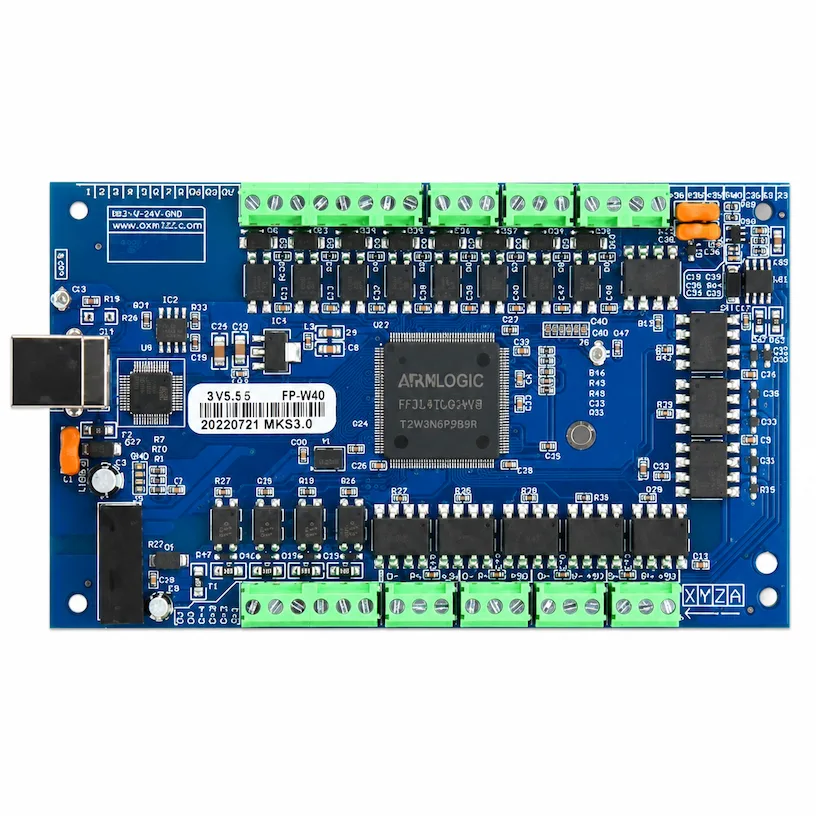
Boards of this type expose the ambiguity physically. Pulse terminals sit on one row, a bus connector on another, and a separate set of pins serves the spindle. Which one a machine uses decides what the controller has to speak, and the record does not say.
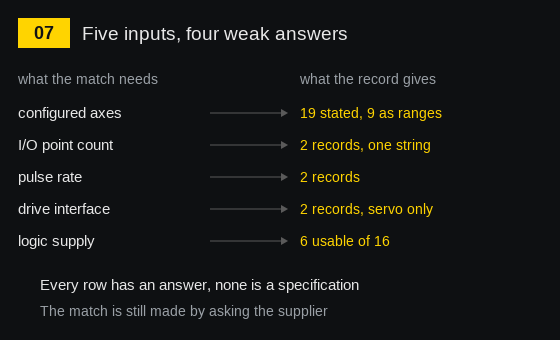
The five rows of the matching table are all answered in this family, and none of the answers is a specification. Nineteen axis counts, nine of them ranges. Two I/O strings, unlabelled. Two pulse rates, one of them ten times the other. Two drive descriptions that name the motor. Six usable supply values out of sixteen.
Filled in is not answered
Memory is the clearest example. Eighty records fill the field. Seventy-six of those entries read none, other, or a capitalised variant of the same two words. Four carry something a reader can use: 128M twice, HMI once, and a seven-inch HMI screen once.
Voltage is similar at a smaller scale: sixteen records, ten of them reading other, and six carrying a usable figure — 24V three times, 24VDC twice, 24V 5A once. Power is the extreme case: nine records, every one of them reading other.
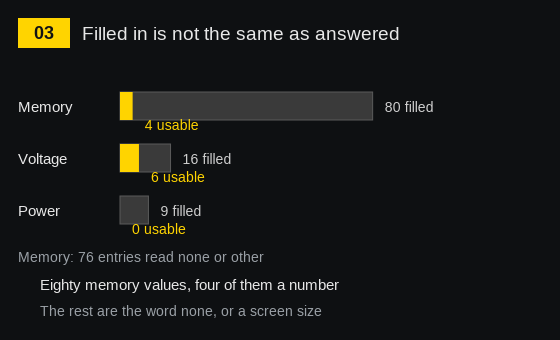
This is the failure mode that makes catalogue data harder to use than no data at all. A field that is eighty per cent filled invites a filter. A filter on Memory returns eighty rows, four of which describe a memory size, and the other seventy-six describe the seller's relationship with the question.
Application narrows the family, not the fit
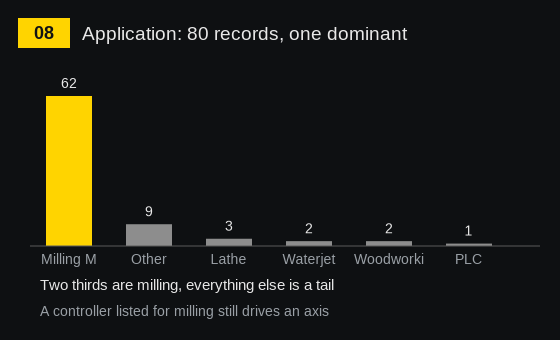
Eighty records state an application, and sixty-two of those say Milling Machine. Nine say other, three say lathe, two waterjet, two woodworking, one PLC, and one reads none. Fifteen records leave the field blank.
That distribution is useful for one decision only: whether the family is built around milling. It is. It says nothing about whether a given controller drives the specific mill on your floor, because the same controller listed for milling may be sold with a two-axis configuration and a lathe may need nothing more.
Three accuracy numbers, three meanings
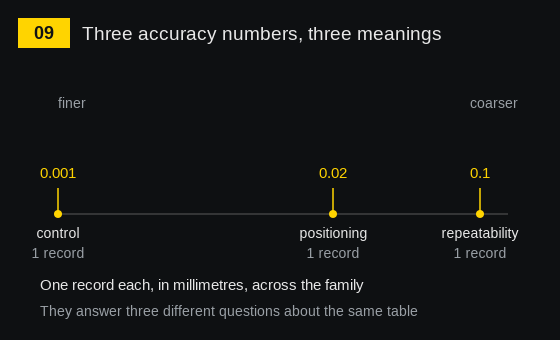
Three records state an accuracy figure, and each states a different kind. One gives plus or minus 0.001 mm as control accuracy, one gives 0.02 as positioning accuracy, one gives 0.1 as repeatability. One record each, in millimetres, across ninety-five.
They are not three measurements of the same thing. Control accuracy describes the resolution the controller works to, positioning accuracy describes where the table lands, and repeatability describes how closely it lands there twice. A machine can be excellent on the first and poor on the third if the mechanics are loose. The same split applies to probe repeatability versus accuracy.
What to send before ordering
The family cannot answer the five matching inputs, so the buyer has to. Send these five, each with the machine-side figure attached:
- Interpolating axes required, and whether any axis is a slave or a spindle.
- Discrete inputs and outputs required, counting safety devices, and spare capacity wanted.
- Maximum pulse rate the fastest axis needs, derived from rapid speed and resolution.
- Drive interface the existing amplifiers accept: pulse and direction, analogue, or a named bus.
- Logic supply available in the cabinet, with its tolerance.
Ask for the answer in the same units and the same direction. A reply that says sixteen in and twenty out is a specification; a reply that says 16/20 is the same string that started the problem.
The summary
Across ninety-five records the family states two I/O counts, two pulse rates, nineteen axis counts of which nine are ranges, and two drive descriptions that name the actuator rather than the interface. It states ninety-four origin countries and eighty-nine weights.
The weight of documentation sits where the risk is lowest. The matching calculation lives in the fields with the fewest entries, and no amount of reading will extract a number that was never written. That is not a reason to distrust the family; it is a reason to treat the record as a starting point for a question rather than an answer to it.
The controllers themselves are ordinary industrial hardware, and a machine builder who has fitted a dozen of them knows the arithmetic. What the record changes is only how much of that arithmetic has to happen in conversation instead of on the page.